 As a Team USA weightlifter, setting incredibly specific goals is nonnegotiable for Abby Raymond. Because a single pound of weight on the bar could be the difference between a win or a loss, the granular focus on numbers is key to success. But it’s not always easy to predict performance like that, so Raymond has had to learn to balance ultra-specific goals with a more global vision of success. Here, she shares her best goal-setting tips for anyone who’s in a data-heavy sport.
1. You can’t do it alone
Setting goals and achieving them is almost impossible to do alone, especially in a sport that has so many data-driven demands, like weightlifting. “I can’t talk about goals without explaining that I have an amazing coach,” Abby says. “When setting goals, it’s super helpful to have people around you for support: There’s no way I would be where I am today if I didn’t have people around me. They’re there for mental and emotional support, but it’s really the strategic support and the coaching that helps me hit my goals. My coach writes my program, and I would really struggle to do that on my own, without any outside input. I’d hold myself back.”
2. As an individual athlete, you’re ultimately only accountable to yourself
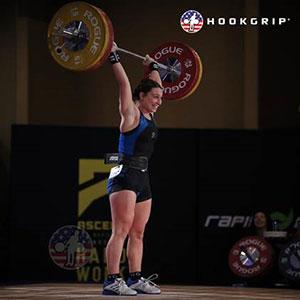 Unlike team athletes who can share accountability when they lose a game, athletes in individual sports are truly only accountable to themselves at the end of the day. “If you cheat the weight in a workout, you’re only hurting yourself,” says Raymond. “You’re not hurting anyone else. You’re the one who set these goals. So, if you’re not doing the work, then you’re the only one to blame when it doesn’t happen. I’ve played the blame game—and there are no winners there.”
3. You have to start with the daily goals
“Small daily goals are so important,” says Raymond. “If you don’t intentionally set those, then you just end up going with the flow, instead of having a strategy behind what you want to do. You’ll end up 10 years down the road and likely won’t have achieved any of your big goals. The daily goals can be simple: eating three balanced meals a day instead of just snacking, getting to the gym at a certain time, and completing your workout to the best of your ability—it’s not always easy, but these daily actions add up to allow you to meet your big goals.”
4. Always keep the long-term goals in mind
The Olympic and Paralympic Games only come around once every four years, which means that those athletes need to focus on the daily processes, while maintaining their focus on a primary goal that is often years away. “Yes, we have the daily goals and then the monthly goals, and then the quarterly goals,” says Raymond. “But we’re always keeping that long-term goal in mind. You plan for the next local meet, but you’re also thinking ahead to the bigger international meets that will happen a few months from now.”
5. You have to know the numbers—but not fixate
In a sport like weightlifting, it all comes down to numbers, both in body weight for your category, and then pounds of weight in each lift. “Everything I do is numbers, whether it’s tracking my body weight, tracking my macros and the number of calories I’m eating, or the actual weight I’m lifting on the bar,” says Raymond. “At the end of the day, it’s the person who lifts the most weight who wins. It’s an extremely objective sport. So, you need to know your numbers, but at the same time, you can’t spend all your time thinking about them. When I start fixating on a number, I really start to struggle.”
6. This is particularly true for body weight
 It’s impossible to ignore the fact that certain sports, like Raymond’s, are weight-focused. There are weigh-ins for competitions to determine what class you’ll be competing in, and that means athletes need to know their weight and pay attention to the number on the scale. That isn’t always easy, especially as it pertains to goal setting. “I think whenever weight is put into the equation, that’s something you have to really prepare your mind for because it can be dangerous to a positive body image,” says Raymond. “I’ve really tried to separate the two. I’ve learned to recognize that my body is a fuel source, and it’s what gives me the power to do what I love.”
She adds that the coaches that she’s worked with typically don’t let young athletes cut weight, because they’re focused on building muscle and strength at a younger age, and then when the athletes are done growing, they can settle into the appropriate, natural weight class. And if an athlete plans to cut weight, she adds that it should never be done solo. “There’s no way I could do it on my own,” she says. “This isn’t easy to do while maintaining performance, so you need to have some type of guidance from a professional who can support you.”
7. Learn how to brush off the losses
You can train for months and still miss a lift, says Raymond. It’s what you do after that failure that makes or breaks you as an athlete. “You will have disappointment that you feel in the moment when you have a failure because of the expectations that you create for yourself,” she says. “But how you cope with it after can make or break you. You can choose to dwell in that failure, or you can acknowledge the failure, learn from it, and move on.”
8. Don’t let sporting success define you
Finally, Raymond says that in a sport that is so numbers-driven, it’s tempting to attach your self-worth and your identity to those numbers. But it’s important to separate yourself from your successes and failures in sport. “It’s so easy to wrap up your identity in your sport, and when you have that mindset, it’s going to lead to burnout or depression. It’s not going to bring you long-term success,” Raymond says. “But remind yourself that your sport is just a thing that you do—and you do it because you love it.”
_______________________
Takeaway
Setting goals in metric-heavy sports like weightlifting often means setting numbers-based outcome goals, but those goals need to be combined with daily and seasonal process goals. Finding a balance between knowing your numbers while staying focused on the process rather than the result is key to success.