

 As a young athlete, it’s natural to feel like there are many things in your life that are outside of your control. But often, we underestimate just how much control we do have over interactions with other people, including coaches, parents, officials, physicians, dietitians, and even our peers and teammates.
Here, TrueSport Expert Amanda Stanec, PhD, the founder and owner of MOVE + LIVE + LEARN, is sharing a few tips for creating better connections within your sport circle by showing those around you how they can support you, and how you can support them.
Remember that in every interaction, you’re a human first
“An athlete is a person who happens to play a sport,” Stanec says. “The athlete is a human first, one who hopefully has a wide variety of hobbies and interests. So, I think the first thing to remember as you interact with others is that you matter as a human, not just as an athlete. Keep that in your head as you help others understand your needs, and keep that in mind when interacting with peers.”
You have the right to set boundaries
 “I think athletes should have boundaries and be able to communicate these boundaries in a way that is respectful,” Stanec says. “For example, if a coach is rude, it’s not mentally tough for an athlete just to receive that and not react. If the coach is rude, ideally an athlete can say, ‘Respectfully, I don’t understand what you want me to do. Can you please help me understand?'” Remember that even adults struggle to take criticism gracefully, so you may find that the conversation isn’t immediately productive.
Check your own behavior
While you absolutely should have the agency and ability to tell a coach or other adult how you want to be treated, it’s also important to check yourself regularly. If you feel like a coach has been criticizing you unfairly, it’s a great idea to have that conversation. But it’s also important to ask yourself honestly if there is any validity to their critiques. Can you learn from them, even if the delivery wasn’t ideal?
Teammates are people, too
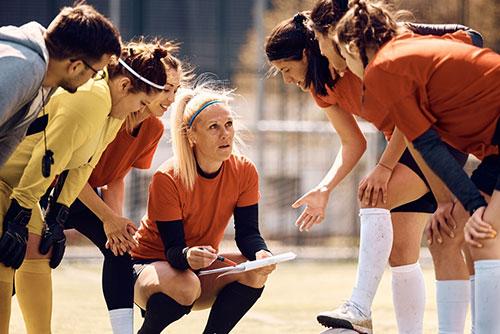 At any age, it’s easy (and often healthy!) to put ourselves in the role of the ‘main character’ of our lives. This can be a great thing, since it helps us focus on reaching our goals and standing up for ourselves. But it can also occasionally cause us to not see that other people are main characters in their own right. For example: During a competition, you perceive a teammate as hogging the ball or not passing to you. The ‘main character’ version of this story is that the teammate is angry at you and purposely didn’t pass you the ball. But Stanec points out that perhaps the other player didn’t see you, or maybe was having a bad day because of a bad test score. Always remember that your teammates are humans too, and assume the best when it comes to their intentions. That said—don’t be afraid to have a conversation after the game, since perhaps this is a chance to work on passing skills for next time!
Be clear with parents about sideline behavior
We’ve all seen ‘that parent’ in the stands: The one who’s screaming at the kids, the coach, and the referee (and often, other parents!). We know how embarrassing and uncomfortable that can feel. If you do have a parent who’s an active fan—meaning they’re at your games and cheering in any kind of way—it can be helpful for you and for them if you sit down ahead of the first game and explain what kind of cheering would be most effective for you. Remember, some parents think that their role is to provide advice, not encouragement. This may come from a place of love, but it’s often unhelpful for you, and can cause confusion on the court. Instead, help them understand that cheering should be strictly encouragement-based, and ideally focused on effort rather than results. Need to simplify more? Tell them to stick to “Go [your name]/[your team’s name]!”
Teach a coach how you learn best
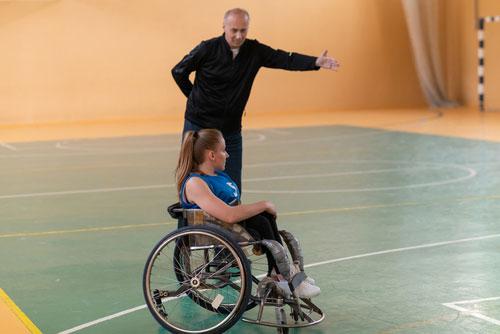 Some coaches are naturally more focused on what you’re doing wrong, while others will only praise what you’re doing right. Some will yell, some will speak quietly. If you feel like you’re not getting the feedback that you need in order to enjoy and/or improve in your sport, it’s OK to ask for what you need.
“You should feel comfortable having these conversations with your coach, asking questions, and trying to learn more,” Stanec says. However, game day is probably not the time for those conversations, for either of you! If you do need to have this conversation with your coach, consider sending a message and asking for a meeting before or after practice. This also helps you take the time to get your thoughts aligned so you can clearly ask for what you need.
_____________________
Takeaway
Many young athletes feel like they have to accept how they are treated by adults and peers alike. But by establishing strong boundaries, explaining your needs, and showing your sport circle how to best support you, you can create healthier connections and thrive in your sport and life.