 Walking through the aisles at the grocery store, you’re confronted with dozens of terms and phrases that are all trying to suggest that a certain food is healthier than another. Some are labeled clean, some are labeled paleo-friendly, some are labeled GMO-free or organic. But what do these nutritional buzzwords really mean, and why does it matter for you as the parent of a young athlete? TrueSport Expert Kristen Ziesmer, a registered dietitian and board-certified specialist in sports dietetics, hears from concerned parents often and has realized that many of the buzzwords labeling our foods today have created a lot of misinformation about nutrition.
Before we look at specific buzzwords that are commonly used today, it’s important to understand why these buzzwords matter. First, the use of these words isn’t regulated, or the terms aren’t regulated the way you may assume. For example, any food with a label that reads ‘clean’ (or that’s referred to as clean) has no regulations surrounding that label. Second, these words can cause certain foods or supplements to have a ‘health halo.’
Here’s what you need to know about some common nutrition buzzwords.
1. Clean
’Clean’ makes its way onto labels and onto the covers of cookbooks with stunning frequency these days, but it has no official definition as it applies to food. “Clean has zero technical meaning whatsoever,” Ziesmer says. “And everyone’s definition of clean is so different based on someone’s biased opinion of what good nutrition is.” Just because something claims to be clean doesn’t mean it’s actually healthy, or that it’s healthy for your athlete. Ziesmer also notes that calling certain foods ‘clean’ implies that other foods are ‘dirty’ or ‘bad.’ Setting up this black-and-white view of foods can lead to disordered eating patterns for athletes, and cause confusion around what they need in order to fuel for the work that they’re doing.
2. Cleanse/Detox
 Rest assured that your athlete doesn’t need a cleanse. And if they did need to rid their body of certain toxins, the juice section of the grocery store wouldn’t be the place to do it. From single serving juice shots that promise gut or liver detoxifying to week-long juice cleanses, the idea of ‘cleaning’ the body and ‘ridding it of toxins’ has become more prominent in recent years, but “the body already has its own natural detoxification system,” explains Ziesmer. “Those systems certainly could get overloaded if your athlete has a medical condition, but that’s where you would want to be working with a medical professional and not doing a juice cleanse for three days. Toxic mold exposure won’t be solved by drinking celery juice: You need to see a doctor.”
3. Superfood
It seems like every week, there’s a new food that’s been granted the title of superfood. From kale to chia seeds, there are plenty of foods that have risen in popularity in recent years. And while many of these so-called superfoods do have health benefits, there’s no specific designation that makes a food ‘super.’ Rather, it’s a marketing strategy employed by experts to sell more of a specific food. “Honestly, every whole food can be considered a superfood when you break it down,” says Ziesmer. “Blueberries and strawberries are packed with fiber and antioxidants. Kale has a ton of micronutrients and fiber. But when these foods get put in the spotlight and called ’superfoods,’ we tend to overdo them at the cost of eating a wider variety of foods in a day.” And again, because there’s no regulations around the term ’superfood,’ it’s easy for marketers to slap that moniker on every product or supplement they’re producing.
4. Anything labeled Paleo/Keto/Whole30/Vegan/Gluten-Free
 “If you go to the grocery store and look at labels, you’ll see things like Paleo-friendly, Whole30 approved, Keto-friendly, vegan, or gluten-free,” says Ziesmer. “That’s not necessarily bad, but it is misleading because it creates this health halo around the product. Something that’s vegan can be packed with sugars and saturated fats, as can something that’s gluten-free. Unless you are gluten intolerant, the gluten-free bread is not healthier than the loaf of whole wheat bread.” She also adds that for a young athlete, unless advised by a doctor or dietitian for some medical reason, there’s no reason to adhere to a Whole30 or keto diet, since those diets cut out most of the carbohydrates a young athlete needs to perform at their best.
5. Organic versus Non-GMO
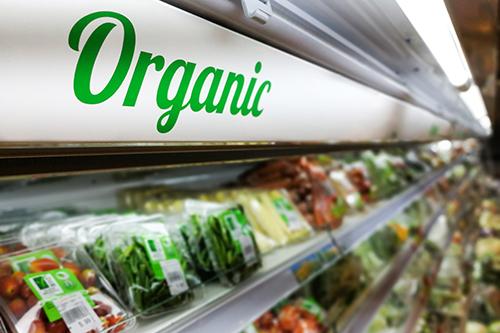 These buzzwords can be confusing because most people assume that they mean the same thing, but they do differ in important ways. Essentially, organic food is always non-GMO, but non-GMO food isn’t necessarily organic. A non-GMO tomato is simply not a genetically modified organism, meaning the plant hasn’t had its structure changed. However, a non-GMO tomato may still be sprayed with chemical pesticides and planted in chemically fertilized soil. On the other hand, an organic tomato will be non-GMO and will be free of any pesticides or other manmade chemicals.
“The FDA does say that GMO foods are perfectly safe,” says Ziesmer. “From a health perspective, I prefer organic options since it’s better for your system to skip the extra chemicals. However, if you can’t afford organic options, don’t avoid fruits and vegetables because of that. Just do the best that you can.”
__________________________
Takeaway
When shopping at the grocery store, beware of labels like ‘clean’ or ’superfood,’ as these words have no technical meaning and are used for marketing purposes. It’s also important to understand the benefits (organic) or lack thereof (detoxifying) of foods with these labels.