

Content Warning: This article contains mentions of suicide and eating disorders.
Being a perfectionist might sound like a positive trait, but for a young athlete, it can be deadly. Athletes who suffer from maladaptive perfectionist tendencies are at a high risk for anxiety, depression, burnout, and even suicide. And unfortunately, with social media, commercial opportunities for younger athletes, and pressure to perform from all angles, it’s easy for athletes to fall victim to a negative perfectionist mindset.
As an athletic trainer, though, you may be in a unique position to identify and address this issue. Athletes might be more open and honest with you than they might be with a coach or a parent, and you can help them find a healthy balance of striving for progress while not falling into the trap of perfectionism.
Here, TrueSport Experts Michele LaBotz, MD, a sports medicine physician, and Kevin Chapman, PhD, a clinical psychologist and founder of The Kentucky Center for Anxiety and Related Disorders, share a few warning signs that perfectionism is taking a dangerous turn and explain what you can do to help.
Maladaptive versus striving behaviors
 Sometimes, perfectionist tendencies can be fairly benign—but in many cases, perfectionism can be a dangerous trajectory. “Striving for perfectionism is basically intrinsic motivation that an athlete has to do as well as they can,” says LaBotz. “There’s initial disappointment when they don’t meet their expectations, but they don’t really beat themselves up. Where perfectionism is concerning is when it’s maladaptive. Athletes dealing with maladaptive perfectionism can’t cope when their performance isn’t perfect. That can lead to some severe mental health consequences, from burnout to suicide.”
“Athletes tend to set incredibly high standards for themselves, and having high standards is essential as a high-level athlete,” adds Chapman. “But when the failure to meet those high standards leads to negative social, emotional, or even physical consequences, that’s when perfectionism becomes a problem.”
Look beyond the surface
It’s easy for athletic trainers and coaches to assume that the athletes they work with are doing fine, especially if on the surface, things seem to be going smoothly. They’re getting good grades, setting personal records, showing up with perfect attendance—but the outward appearance that everything is fine doesn’t always reflect what’s going on under the surface, says LaBotz. “An athlete may appear to ‘have it all’ on the outside, but it isn’t necessarily reflective of how they feel inside. Those of us who care for these athletes should not make assumptions based on what you view the athlete’s life to be like.”
Recognize the impact of social media
Social media has become another reason that athletes have developed standards that aren’t only difficult to meet, they’re literally impossible. A high school athlete scrolling social media is now exposed not just to their teammates, but to every other athlete in the world. And they’re only seeing the ‘highlight reel’ of poses and positive moments that are often edited and filtered to tell the most flattering story. It can be a red flag if athletes are comparing themselves to others on social media or asking how they can make themselves more like someone else.
Recent changes that now allow young athletes to attempt to make money from their name, image, or likeness (NIL) through social media and other channels may place even greater pressure on those who choose to pursue NIL opportunities.
Be cognizant of body dysmorphia
 It’s often easy to be dismissive of a young athlete’s complaints about how they perceive their body. It is fairly common to hear a fit and healthy young athlete say they want to lose weight or build muscle, and it can be easy to instantly dismiss that desire as silly or unimportant. But persistent concerns about weight loss, body image, or statements indicating that what an athlete sees in the mirror is not in line with reality is a sign that your athlete may be struggling with body dysmorphia.
“Many athletes—men and women—have negative perceptions of their bodies,” says Chapman. “Pay attention to how an athlete talks about their body and recognize that perfectionism can cause dysmorphia or even problems with eating disorders.” Warning signs of emerging eating disorders include athletes with increasingly restrictive diets or those who choose not to eat in team settings.
Look at how your athlete complies with training recommendations
“Something to be attentive to is if an athlete’s overworking their body,” says Chapman. This may be subtle, where the athlete appears more fatigued, or more obvious, where the athlete is clearly pushing past their limits. “If you’re noticing an athlete doing things despite medical advice from you or another professional, that’s a red flag,” he adds.
Understand how much impact you can have
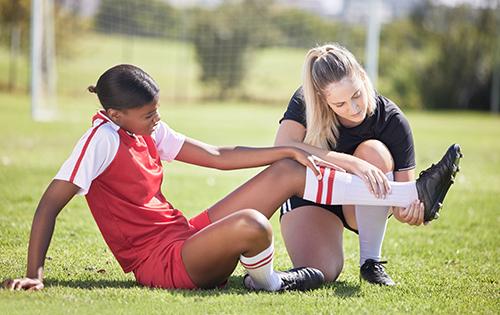 Athletic trainers are uniquely set up to ask the tricky questions and have those one-on-one conversations that a coach may not have bandwidth or training for. “For a lot of athletes, their athletic trainer is a safe person to talk to,” says Chapman. “They might like their coach, but they don’t want to tell a coach about problems that could get them pulled from a starting lineup or change the way a coach views them.”
Help athletes focus on progress, not perfection
“Progress, not perfection” is a mantra that Chapman regularly prescribes his athletes. And LaBotz agrees. “Help your athlete learn to focus on individual progress, rather than comparing themselves to an unattainable level of ‘perfect’ performance,” she says. “Help your athlete track how far they’ve come this season, or this year. Help them learn to assess their progress on their own terms.”
_______________________
Takeaway
Athletes who suffer from perfectionist tendencies are at a high risk for anxiety, depression, burnout, and even suicide. As an athletic trainer, you’re in a unique position to help athletes by noticing early warning signs of maladaptive behaviors and negative self-talk that can result from the pressure to be ‘perfect.’ Help your athletes understand that a focus on progress rather than perfection is the healthier, more sustainable way to improve in sport.