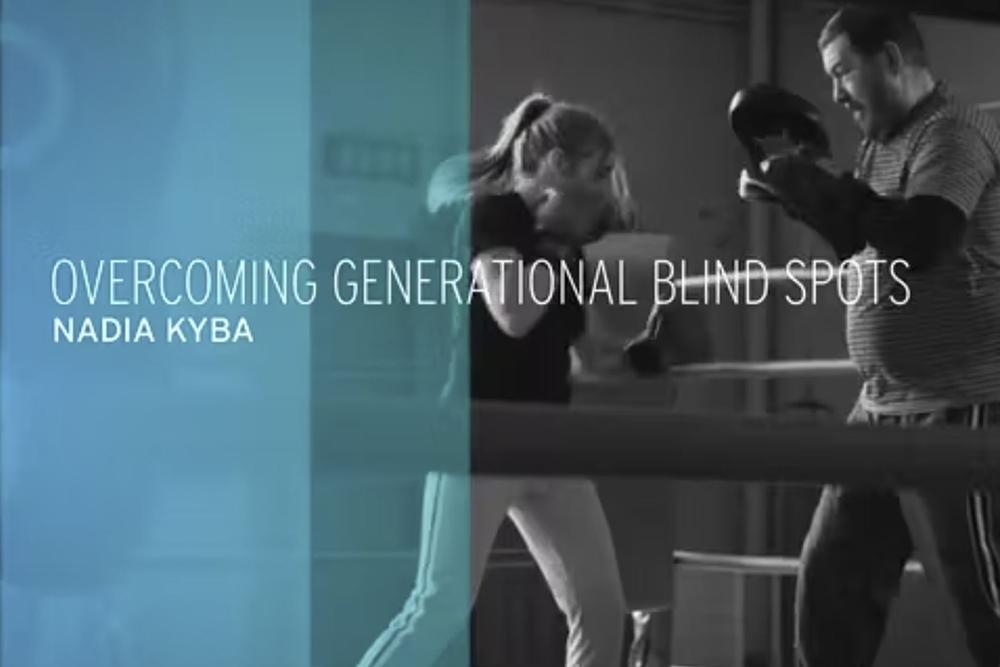
Kara Winger: Hello again. Welcome to another TrueSport Expert Series video in 2022. I’m Kara Winger and we’re here with Nadia Kyba. We’re going to talk about overcoming generational blindspots for better communication and relationships in general. So, generations, kids and parents, me and my grandparents, etc., etc., have different ways of communicating, right?
Nadia Kyba: Absolutely.
Kara Winger: In this time, there’s a lot of change happening, like how can we confront generational blindspots, overcome them and communicate better in sport?
Nadia Kyba: It’s a great question and I’m really excited about this topic because I see it happening a lot in sport just starting out with what do we mean by generational blindspot. Yeah. So, generational blindspots really are contributed to by the way that we see the world, by the way, depending on when we’ve been raised and how we’ve been raised and our age, and they contribute to this whole idea of when we think things should be a certain way. And that’s where we sometimes will find that we have blindspots because in our minds, maybe they should be a certain way, but for someone who’s 20 years younger, they should be a different way. And certainly that impacts communication, it impacts language, and it can cause a lot of rifts where people are making assumptions about each other and forming beliefs that are not based on what’s actually happening.
Kara Winger: I get intimidated by like pop culture as younger generations like come up and are in the workforce, are on my teams. I don’t know what they’re talking about, whether it’s a TikTok dance or like the newest music. And I, you know, I’m not embarrassed that I’m dating myself because it’s a natural thing growing older. And how can we bridge that gap, whether it’s social media or pop culture or what have you? How do we make that leap to communicate intergenerationally? What’s the most important thing?
Nadia Kyba: Well, I think that it’s important to be aware of where your blindspots are. So, rather than assigning a value to it, so, the way that I communicate may be as a head coach who’s 45 years old, would be by emailing. And my expectation is that if I’m working with an assistant coach who’s 20 years old, that they respond to my email and acknowledge that they’ve gotten it and maybe answer the email if there’s a question involved. However, I think that for the younger generation that’s not part of their culture. So they don’t feel the need to send that response email. They just get the email and take in the information and then move forward. Whereas I may think that that’s rude or that they’re poor communicators and yet they’re not in terms of their generation. So, I think that just being open to understanding that different generations do things differently and understanding some of the reasons behind why they do what they do. In my mind, the core to all of this is relationship building. The core is solid communication and working together as a team, whether that be a sports team, whether that be a team of coaches or a team of sports administrators. It’s about building relationships so that if there is misunderstanding, that’s based on things like generational blindspots, you’re able to communicate about that and the way that you build relationships is getting to know each other outside of the platform that you know each other on. So using social media and just understanding where people are coming from and why they do the things that they do.
Kara Winger: Yeah. What makes them tick, what they’re interested in, like just shooting a post to somebody lets them know that like something about this resonates with me as a human being, like at my core. And that’s just such a cool component of the world that we live in now. We are socially distanced, but we can have so much more in common because people are so interesting and we relate to them in a different way in all these different avenues of communication to build relationships, love it. So ,how important is it to, in the spirit of building relationships, just state your needs, like know what your needs are so that you can build a relationship with somebody that you need to communicate with effectively?
Nadia Kyba: It’s so important because to me that comes down to trust. And if you don’t trust someone, you’re not going to be able to work well together. So, if you don’t trust someone to respond to an email or a text or whatever, where you’re communicating within a timeframe that you’re needing, then you’re going to have a lot of difficulty moving forward. I hear what you’re saying, if that’s not how they communicate, that’s fine and great. The key is to have that open conversation about what both of your needs are and what your preferences are, and then come to an agreement on how you are going to communicate. And then if one of you isn’t doing what you say you’re going to do, have that conversation like, hey, we agreed to communicate within 24 hours of getting a text, text back, or email an acknowledgment that you received my email, whatever it may look like, but have a clear agreement and a guideline of how you’re going to work together.
Kara Winger: Yeah, set the expectation early. I love that. Especially if you are in a coach-athlete relationship. That’s much closer than what I’m doing right with these fellow athletes and so much more important to keep building that relationship. So, is that one of the benefits of overcoming these generational blindspots? Like what are some great things that can happen when you communicate well across generations?
Nadia Kyba: Well, you, first of all, are then able to manage conflict when it comes up, because that’s very normal. And if you are making a whole bunch of assumptions about people based on generational blindspots, then you’re going to have a tough time communicating through that conflict because you’ve already got all these preconceived notions about the other person. If it’s someone who’s older, they may think that the younger person is being lazy or they’re just, you know, they don’t know how to write an email anymore or, you know, communicate face to face. And a younger person may just think that the older person’s out of the loop and they don’t know how things are done these days. And one example that I’ve seen recently is I was teaching a course at a university and they were taking notes on their phones. And my assumption was that they were all on Snapchat and I started to get upset about that. And I think that that happens with coaches a lot as well. And it could be that they’re using phones as a way to document what’s happening at practice. Another example is that I see the younger generation doing more is they’re very open about talking about mental health and mental wellness and that makes some older people a little bit uncomfortable. Right? So, having that conversation about, you know, are we going to have these conversations on our team? What are they going to look like considering everybody’s comfort level and just respecting that.
Kara Winger: Yeah. Creating space for conversations that are going to push everyone forward but maybe aren’t something that an older generation is comfortable with. Yeah. That idea of leadership from younger generations is so cool to me that just like any attribute, any trait of a human being, youth and a fresh perspective can really help you grow as an older person, so, super fun.
Nadia Kyba: I absolutely agree. I learned so much.
Kara Winger: So, you know, I’m a pretty good texter. I’m 35. I’ve still got good dexterity, blah, blah, blah. But I’ve also always been really good at in-person communication, conflict management. I have had to have some really difficult conversations in the course of my athletic career to kind of state my own needs in a way that I really had to think through and package for somebody that I know thought differently than me. And I’ve always prioritized doing that in-person. So for me, that’s my comfort zone. But is that always the best way to communicate?
Nadia Kyba: Well, it’s so funny that you’re asking that because I preach in-person communication as a conflict management principle. Like you cannot manage conflict by text or email. That said, I think it’s really important to acknowledge that everybody has a different comfort level with in-person communication and, you know, if you are working with someone who is more comfortable with texting, then it’s incumbent on yourself to be flexible enough that if that’s what they want, that you go with that. And I think that that’s really key and especially right now with the pandemic. I think that a lot of young people are at a practice with the face to face communication. We’ve had the benefit of more years than they have with practicing it and, you know, practicing speaking publicly. And so, just being kind and recognizing that and recognizing that it is a bit of a blindspot for us because it’s not something that we grew up with, texting, whereas this is one of their key communication tools.
Kara Winger: And the honor of like honoring that person’s comfort level. To me, that just shows how much you care about working through this conflict when you as someone who’s maybe more comfortable in-person, can take that to digital communication, be it DM or email or text or Snapchat or whatever. And I also think, like to your point about young people, maybe your athletes, if you’re a coach, not having as much practice at in-person communication, for them to be able to like be at home and take the time to talk to a parent about how to respond to a text message or an email and kind of think all the way through it, think all the way through the communication, respond in a way that is all encompassing and thorough and actually productive can be really helpful. So, digital communication absolutely has its place.
Nadia Kyba: Yeah. And I think that, absolutely, and it goes back to that, the key of building trust. And if you are if you are open to communicating in the way that they’re asking you to communicate, which is by text, you’re building trust. And that’s the key to relationship building. And down the road, then maybe they will be comfortable with that in-person communication. But shutting them down right at the beginning and forcing them to come face to face, you may not get much and you’re losing that opportunity to build trust.
Kara Winger: Yeah, meet them where they’re at. So that in the future you can work together in all the ways maybe. Yeah, it’s very cool. Thank you so much for your insight on generational blindspots today, Nadia, it was lovely talking to you.
Nadia Kyba: It was wonderful to be here.
Kara Winger: And this was one of our TrueSport Expert series videos in 2022. Stay tuned.