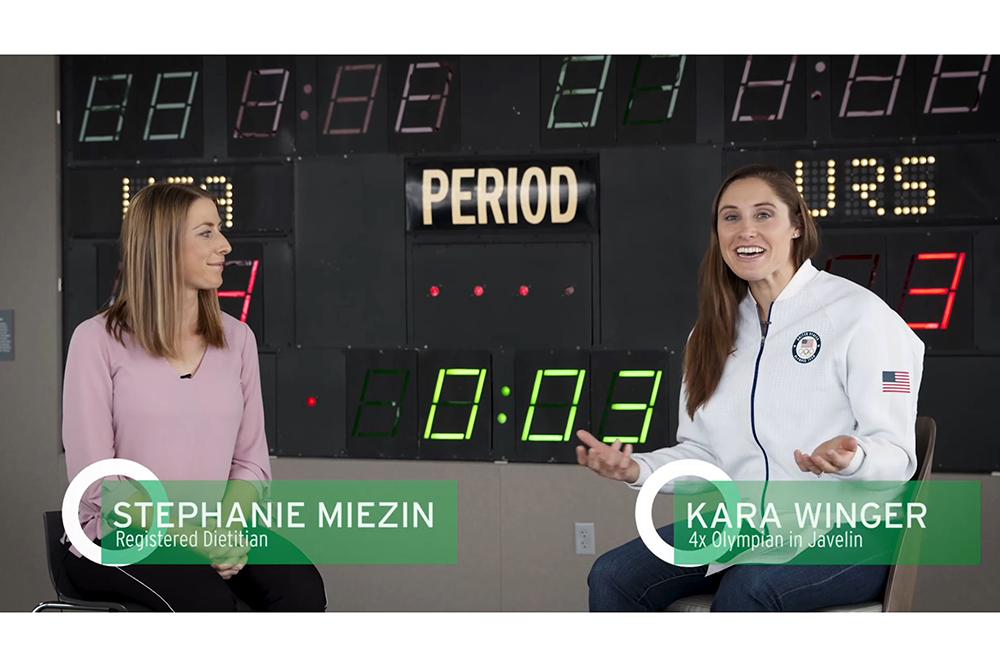
Kara Winger: We’re back. I’m Kara Winger. This is Stephanie Miezen to talk more nutrition. We’re going to talk about something in this TrueSport Expert Series 2022, here in Colorado Springs, that I’m not very familiar with, which is the carbohydrate mouth rinse. So, what is that? Stephanie
Stephanie Miezen: Yes. So, this is a strategy around fueling that was kind of discovered or started to be evolved in like the very late nineties. And so the idea was that they did some research and they found that, OK, you know, under about or up to an hour of pretty intense endurance activity, if we give people a carbohydrate drink, it seems like they have some performance enhancements here. Even if it’s just a small amount, they’re doing a little bit better in their performance. But the researchers were thinking, well, you know, an hour of time isn’t quite enough to really be fully utilizing that carbohydrate, really breaking it down for energy. So, maybe there’s something else going on here. And what they found with a couple more studies is that this idea now of the carbohydrate mouth rinse strategy is that if you take in a little bit of a sweet drink, like a sports drink, and you swish it around in your mouth for 5 to 10 seconds and then you spit it out, you can still get some performance benefits because it’s potentially stimulating your central nervous system, so your brain a little bit.
Kara Winger: Wow.
Stephanie Miezen: But you’re not actually drinking anything or intaking any energy. So, it’s really fascinating how that system is working.
Kara Winger: Yeah, fascinating. But do you recommend the carbohydrate mouth rinse, like is that a long term strategy that we want to be employing, especially with youth athletes?
Stephanie Miezen: Exactly. And that’s where I think we could have research. But then how do we really apply it? That’s so key. And I think when it comes to creating or encouraging healthful behaviors with young athletes, something like intaking a food or drink into our mouth and then spitting it out. Right? That can potentially make some unhelpful connections for young athletes. And so, I think for me that the takeaway when it comes to that nutrition, hydration strategy and young athletes is it probably isn’t necessary. And I would argue perhaps not helpful for younger athletes to explore, because you can still get some of that benefit within this, you know, we’re talking about exercising pretty intensely for an hour. So, a soccer game, basketball game, something like that. Right? You can still get some benefit just by drinking a little bit of sports drink maybe, right?
Kara Winger: Swallowing it.
Stephanie Miezen: Yeah, swallowing. It’s totally fine, right? And if you’re inside like basketball, I don’t think you’re going to be able to spit it out maybe anyway.
Kara Winger: Hundred percent. Yeah. So, we do not recommend it because it doesn’t necessarily build a great relationship with the fuel that you’re putting in your body.
Stephanie Miezen: I think so. I think that’s a good way to kind of sum it up.
Kara Winger: So, what are some great hydration habits? How do we hydrate really well?
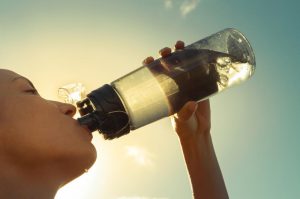
Stephanie Miezen: Yeah, I think trying to rely mostly on water as our main source of fluids is going to be number one. It’s one of the best ways to keep us hydrated and whether it has bubbles in it or whether you put some fruit in it to make it taste good.
Kara Winger: Yes, yes. I love that.
Stephanie Miezen: Or something like unsweetened iced tea that can all add to your fluid intake over the day and things like smoothies, milk, even our fruits and veggies have some water in there. Watermelon is over 90% water. So, I think really focusing on water itself. But we also have tons of space for these other things that aren’t straight water that we’re going to be tasting a little bit better for us.
Kara Winger: Yeah. Making water delicious.
Stephanie Miezen: Yeah. And I think too, for families, it’s always fun to have like a pitcher of water that has oranges or lemons or something like that. And I really like to take frozen berries and then put your water in that because as they thaw, they release all their juices. And so, you really get extra flavor from the frozen fruit.
Kara Winger: Very cool. Yes. And that’s a prepackaged thing at the grocery store. That’s very easy to pick up and super convenient. Throw it in your pitcher.
Stephanie Miezen: Yeah.
Kara Winger: Very cool.
Stephanie Miezen: Have you tried any nutrition habits or strategies that maybe weren’t most healthful?
Kara Winger: I didn’t have a great relationship with food right before I hurt my knee for the first time. So, I was you know, I fell into the vanity part of being a woman athlete, and I thought it was going to serve me well. I thought lighter is faster. You have to go faster to throw the javelin further. But then I tore my ACL. So, after that, really just paying attention to my body and how I was feeling did me best. So, I don’t know that I got too specific with the habits, but a habit that I did learn from not maybe having a great relationship with food that I do think was helpful is I used to love juice and we’re talking about carbohydrate mixes. Like this was just straight up like grape juice, apple juice, like so much sugar. And a way that I cut that down was to mix it with water or mix it with soda water or a LaCroix or whatever. And so, I still really enjoy that, and that’s still part of my hydration habits to make these liquids that I’m consuming fun. So, I didn’t necessarily adopt that habit for the best reasons, but it has really kind of affected how I get more fluids in my life because they’re good.
Stephanie Miezen: Yeah, they taste good.
Kara Winger: They’re yummy.
Stephanie Miezen: Yeah. And I think to your point about learning that lesson perhaps of fueling yourself, it’s that mentality, right, of restriction versus nourishing. Yes. And food is there to help us. And I think sometimes in culture and social media, it’s like food is the enemy. We have to avoid it and restrict it and, you know, all of those things. But if we can switch the mentality so like, no, like the food is there to help me and I can choose these certain foods and certain amounts and times to benefit my body and my health, and performance on top of that, it’s just like a it’s a better way and it’s almost freeing, right, to think of food in that context.
Kara Winger: Yeah. And to really care for that food that’s caring for you. Like I made hot chocolate last night and just with water, which I made it with eggnog at Christmas time and it was phenomenal.
Stephanie Miezen: Yeah.
Kara Winger: But taking the time to heat up the liquid, put the chocolate in it, make sure I’m like mixing it with my, like, whipping little stick. And I bought these, like, special marshmallows, like this kind of ritualistic, like, very intentional creation of this beverage that I’m going to, like, sit and pet my dog and watch a TV show. It is a really fun place to be in my life because that’s what every meal is, this nourishment of my body.
Stephanie Miezen: Yeah, absolutely.
Kara Winger: So, I learned so much about hydration strategies. Really good ones. Water is king, but make water fun. And thank you for teaching me about the carbohydrate mouth rinse technique and how there’s a place for it. But probably great hydration habits are best practice. – So, really appreciate your time. Thank you, Stephanie for being here. And we will be back with even more TrueSport Expert Series 2022.