A young athlete will know if they’re properly hydrated by looking at their urine. If it looks like apple juice, then you are dehydrated. If it looks like lemonade, you are properly hydrated. If it’s clear, then you could be overly hydrated. That’s not necessarily a problem; however, if you’re just constantly overly hydrated, you could be flushing out your electrolytes.
Athletes should ideally start off with a hydration plan. That is preferred over drinking to thirst. However, if you are very in tune with your thirst mechanism, then you could start to transition over to drinking by thirst. I would start off with scheduling out when you’re going to drink throughout the day. A good example would just be having a glass of water every time that you have a meal.
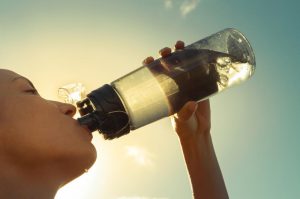
Throughout the day on a regular basis, parents can help their kids by hydrating by just giving them a large water bottle to carry with them throughout the day. So telling them, “Okay, ideally you need to finish this water bottle by noon and then go ahead and fill it back up and then finish it by the time you finish school.” That’s super-easy, and it’s not hard for them to remember to do that.
Then during practice, parents can also say, “Okay, finish this water bottle during practice, and you’ll be good.” Or if they know it’s going to be a long practice or they’re going to be practicing out in hot, humid environments or at a higher altitude, then that’s when they would want to increase their hydration level or even add in electrolytes as well. The parents would really want to advise them on that and provide that.
Athletes should drink mainly water to optimize their hydration for exercise. However, if it’s going to be a training session that’s over an hour, that’s when they need to start adding in electrolytes. If it’s going to be 45 minutes of training and it’s going to be in a hot, humid environment or it’s going to be a very intense training session, then they can add in electrolytes at 45 minutes. But ideally just water; but like I said, if it’s over an hour, then that’s when they would start to add an electrolyte beverage. That can be a sports drink, or you can even make your own homemade sports drink, which is just orange juice, honey, salt and water.
If water is a rejected substance by your child, adding some flavor to it will help. I would first start off with adding fruit to it. Obviously, you could buy lemons or limes or oranges and put that in there, or other fruits like cucumber. Well, cucumber’s not a fruit. But you could add cucumber or strawberries into the water, but you can also buy little packets of dehydrated lemon and lime and orange, and it’s just the fruit that’s dehydrated, and you can pour that in there. That would be better than using flavor enhancers because those have artificial sugars in them. Sometimes they have other things added in them that you really don’t need, like extra electrolytes or caffeine. So that would not be ideal for a young athlete. So really trying to add fruit to flavor it or the packets of dehydrated lemon, lime, or orange would be ideal.
I think the more that you carry around a bigger bottle, the more likely you’re going to drink more of it. Because if you just have this little bottle and you have to keep running to the water fountain to refill it, it’s going to become a pain. So most people don’t wind up doing it that way.