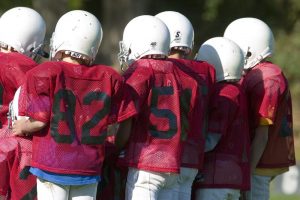
As parents and coaches, it’s our obligation to teach leadership skills. So when we think about leadership as a set of skills, then we won’t look at any athlete and think, “Oh, well, they’re just never going to be a leader.” And that’s great because leadership is associated with strength and achievement and goodness, and not being a leader or a child being told, “Oh, well, you just don’t have what it takes to be a leader,” feels to them like they’ve really done something wrong. Or if they get passed over routinely for leadership opportunities without anybody saying, “Hey, if this is something you want, here’s some skills you could work on together.”
Some kids really shy away from leadership because it’s associated with either an experience or feelings that they haven’t liked, or because they think they’ll fail at it. And we all shy away from things that we think we will fail at. So one of the best ways to raise a leader is to ask them what they think leadership means. Ask them to point out people in their life that they feel are good leaders and why. And then to ask them if they see any obstacles to themselves being a leader, or if that’s a role that they think they would want.
Then, and this is the really tricky part, but adults are really good at it because you’re an expert in your athlete, catch them being a leader. When they talk their sibling into watching the movie that they really want, that’s leadership. When they make an argument for doing their chores tomorrow or getting the bigger piece of pie, or when they convince or influence someone towards either a great goal, something you really admire, or something you can be neutral about, there’s nothing negative about wanting the bigger piece of pie. Then you can catch them in it and say, “That was a leadership skill.”
The first thing that leaders need to know how to do seems counterintuitive. They need to be able to watch and notice. That ability to hang back for a minute, to not just rush in headlong, make snap decisions about what everybody needs or what they want or what I want and just do it and not really think about how it lands with anyone else, that’s the opposite of the leadership qualities that we’re looking for. When you notice an athlete who observes, who takes it in, ask them about their insights. Because insight, that ability to watch and notice and then make a conclusion from it, that’s a really important leadership skill. So that’s about a situation.
Another skill that’s really important is to be able to evaluate, to evaluate what the people around you are good at and what their obstacles or their challenges are. Leaders have to be able to do that. So asking your athlete after a game, “Can you tell me your own strengths and obstacles this game? But also, can you tell me who excelled at this game and how? Who improved this game, and how? And who experienced challenges this game? And why do you think they experienced that?” Then you’re asking them to look critically, but not in a way that says judgemental and negative, just to critique the experience. Leaders have to be able to evaluate individuals and groups to know what they’re good at and what their challenges are going to be to be able to recruit people towards a goal.
And then the third skill is leading people to a goal. So if I’ve got enough insight to understand what a valuable, admirable goal is for my group, and I’ve got the evaluative skills to figure out who’s good at what and who’s not so good at what or who improved at something, now I have to be able to influence. And influence is something that kids work on themselves their whole lives. They work on it with their siblings, with their friends, with their teammates, with you. And so recognizing when they’re good at it and rewarding it when they use it respectfully and with good intention, now you’ve got a leader on your hands. Someone with insight, someone who can evaluate, and someone who can influence towards a positive goal.
I want to tell you about an activity that you can do with your athletes as a team that’s collaborative and yet teaches leadership skills and draws your conversation around to leadership and what good leadership looks like. So here’s what you do. Gather all of your athletes and say to them, “In a minute, but not yet, you are going to create, as a group, a shape. I’m going to name a shape. And you as a group are going to create that shape. Here are the guidelines. Everyone has to be involved in the creation. When the shape is done, everyone has to be in use making it. You have to use branches or sports equipment or something so everybody stays six feet apart. But the outline, from a bird’s eye view, has to look like the shape that I’m suggesting. And the shape is.” And you might say a square or a triangle or an octagon or an infinity symbol or a football, it doesn’t matter.
Let them play this a couple, three times, maybe two or three times. And once they think they’ve got it, they all raise their hand. They have to agree they’ve got it. They all raise their hand. You come over, you look at it, you tell them if they have it or they don’t, they fix it. And once they’ve got it, they’ve succeeded. This is not a competitive game, it’s a collaborative game. Now you say to them, “Okay, everybody.” You stand in the middle and you say, “Everybody look at me. For this next round, we’re going to do the exact same thing. But everybody that I point to and make eye contact with or say your name isn’t allowed to talk. And because these are our rules, you can’t go up and physically touch each other. So only the people that I don’t look at and say their name are allowed to talk in this next round.”
And I would suggest knocking out about a third of them. But you know who. I don’t know who to knock out. But you already, even before you do it, you know who you’re going to knock out of this game because those are the people who keep leading. You’re going to play a couple of rounds that way. And then you may say, “Okay, if I say your name …” And it adds. So the people that can’t talk, they can never talk again in this game. But you might have to say, “If I say your name now and you already couldn’t talk, it means you can’t even gesture, grunt, dance. You just have to do what you’re told.” And now I want you to get down to a sixth of your team are the only ones who are allowed to talk. And probably several of them aren’t even allowed to be like, “Go over there, do this” with their gestures.
In this experience, that collaboration is valuable. But what’s really valuable is the conversation afterwards. Everybody sit down right where you are and tell me something you noticed or learned about yourself. This is an I statement. So about your own experience with that. How was that? If you were somebody who was silenced early, how did that feel? If you were somebody who wasn’t silenced or wasn’t silenced until the end, how did that feel? What did you learn? What did you notice? Get them into a conversation about who speaks up and who doesn’t, who leads. And I don’t mean the names of the people. I mean, in what situations do people speak up or don’t? What’s an obstacle to speaking up? How does it feel to be relied upon when it wasn’t your inclination to speak up? And you will learn and hear some really interesting things from your team about leadership.